


Over the past few years, businesses have become more sophisticated in how they manage advertising campaigns. Creative testing has become more systematic, audience targeting more precise, and campaign strategies more data-driven. Yet as more businesses expand into global markets, the challenges associated with growth are also changing. Business priorities have shifted from ad traffic acquisition to running stable, large-scale global ad campaigns.
As Advertising Scales, Complexity Extends Beyond Campaign Management
As businesses add more ad accounts and increase campaign spend, marketing teams must manage Google, Meta, TikTok, and other platforms across multiple countries and regions. Finance teams, meanwhile, face a growing workload spanning budgets, payments, and reconciliation.
If the way spending is managed does not evolve at the same pace, issues once resolved manually can gradually become barriers to operating at scale.
A Sudden Account Restriction May Not Be Caused by the Campaign Itself
A campaign manager opens the platform dashboard and discovers that an ad account has been restricted. After checking the creative, copy, and landing page and finding no apparent issue, the team receives a notice from the platform:
This account has been restricted due to policy violations by a linked account.
Many businesses use a single corporate credit card across multiple ad accounts. As the number of accounts grows, platforms may treat accounts linked to the same card as belonging to the same entity. If one account triggers risk controls because of a policy violation, other linked accounts may also be affected.
Campaigns Keep Running, but Budgets Become Harder to Control
One afternoon, the marketing lead receives an alert:
Campaign XX may stop running soon due to insufficient budget.
One campaign is running short of budget, while another still has a substantial amount of unspent funds.
When different teams and markets run campaigns simultaneously, budgets get spread across multiple ad accounts and payment accounts, making it harder to track how funds are being used in real time.
Ad Spend and Bank Statements Do Not Always Align
At month-end, Finance sends a message:
There is a USD 2,300 difference between this month’s bank statement and the advertising platform records. Can you help identify the transactions?
The campaign manager spends the entire afternoon searching but still cannot find the answer. The issue may not be an incorrect calculation. Instead, it may be the lack of a unified view across advertising platforms, bank accounts, and refund records.
As the number of ad accounts, platforms, and currencies grows, manual reconciliation becomes increasingly time-consuming. Refund delays, exchange-rate fluctuations, and settlement cycles can make discrepancies even harder to trace.
Once Advertising Scales, Managing the Funds Behind It Becomes a Core Priority
Account restrictions, loss of budget control, and reconciliation difficulties may occur at different stages, but they all stem from fragmented advertising spend management.
At this stage, businesses must manage the budgets, payments, and fund flows behind each account—not just the accounts themselves.
- Where does every ad dollar go?
- Can we spot and resolve risks ahead of time?
- Can we track every expense from start to finish?
When these issues begin to affect ad account stability, budget accuracy, and cash flow efficiency, advertising spend management shifts from a back-office support function to a core operational capability.
Oceanpayment Card: Streamlined Spend Management to Match Your Scaling Ad Campaigns

Across the full cross-border advertising payment lifecycle—from funding ad accounts and monitoring campaign spend to reconciling expenses—Oceanpayment Card helps businesses manage advertising funds through a unified, efficient, and traceable workflow.
Before Campaigns Begin: Manage Each Ad Account Independently
Oceanpayment Card provides purpose-built virtual cards for advertising and other marketing expenses.
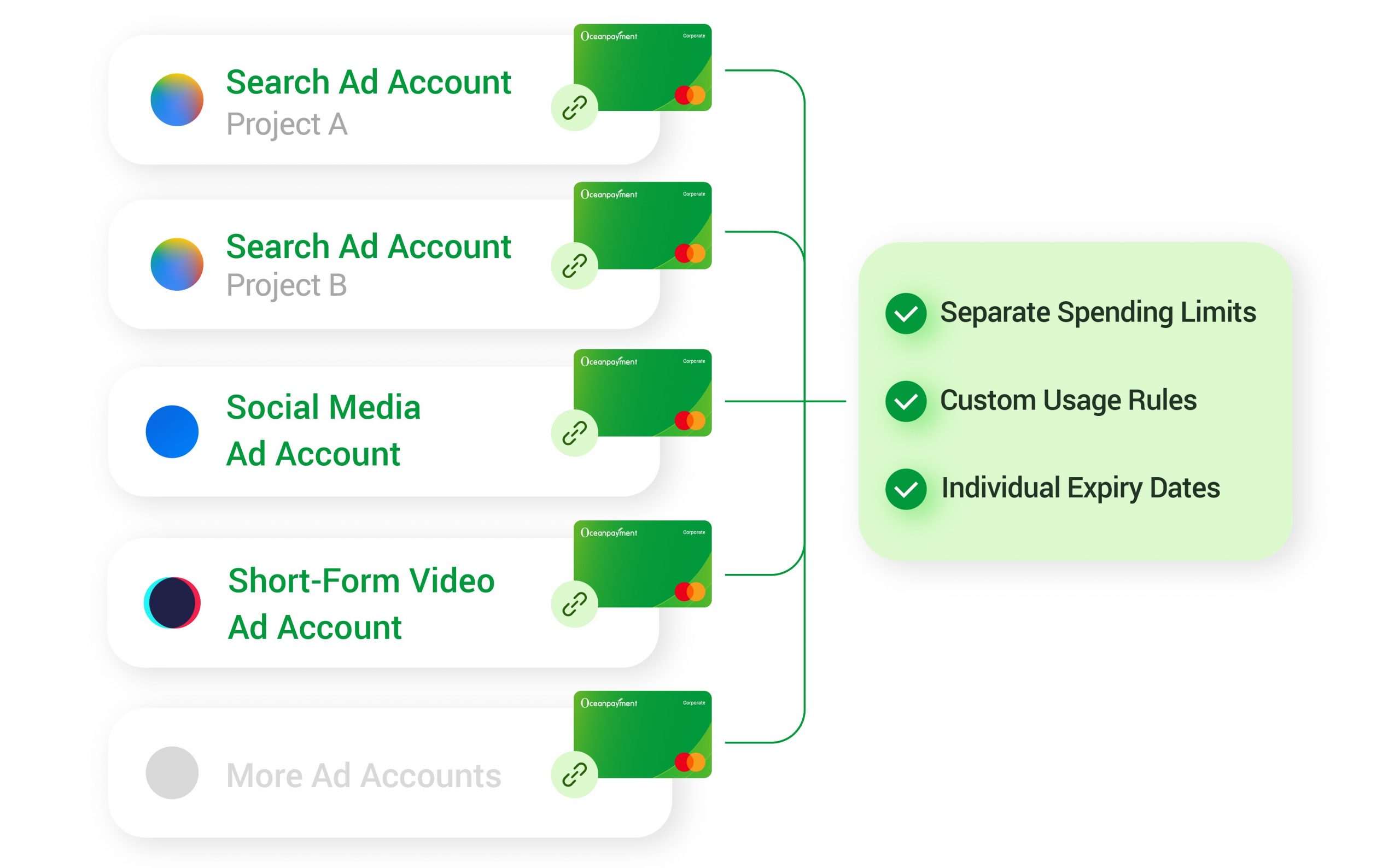
Funds can be managed independently across different accounts, with separate spending limits, validity periods, and usage rules. This makes it easier to allocate budgets and track spending by account, project, or market, while reducing the commingling of funds and the management complexity associated with shared payment methods.
Businesses can configure virtual cards by advertising platform, ad account, or campaign to keep each advertising expense clearly attributable.
During Campaigns: Make Every Transaction Visible in Real Time
During campaigns, Oceanpayment Card provides real-time transaction visibility, giving businesses a clear view of how advertising funds are being used.
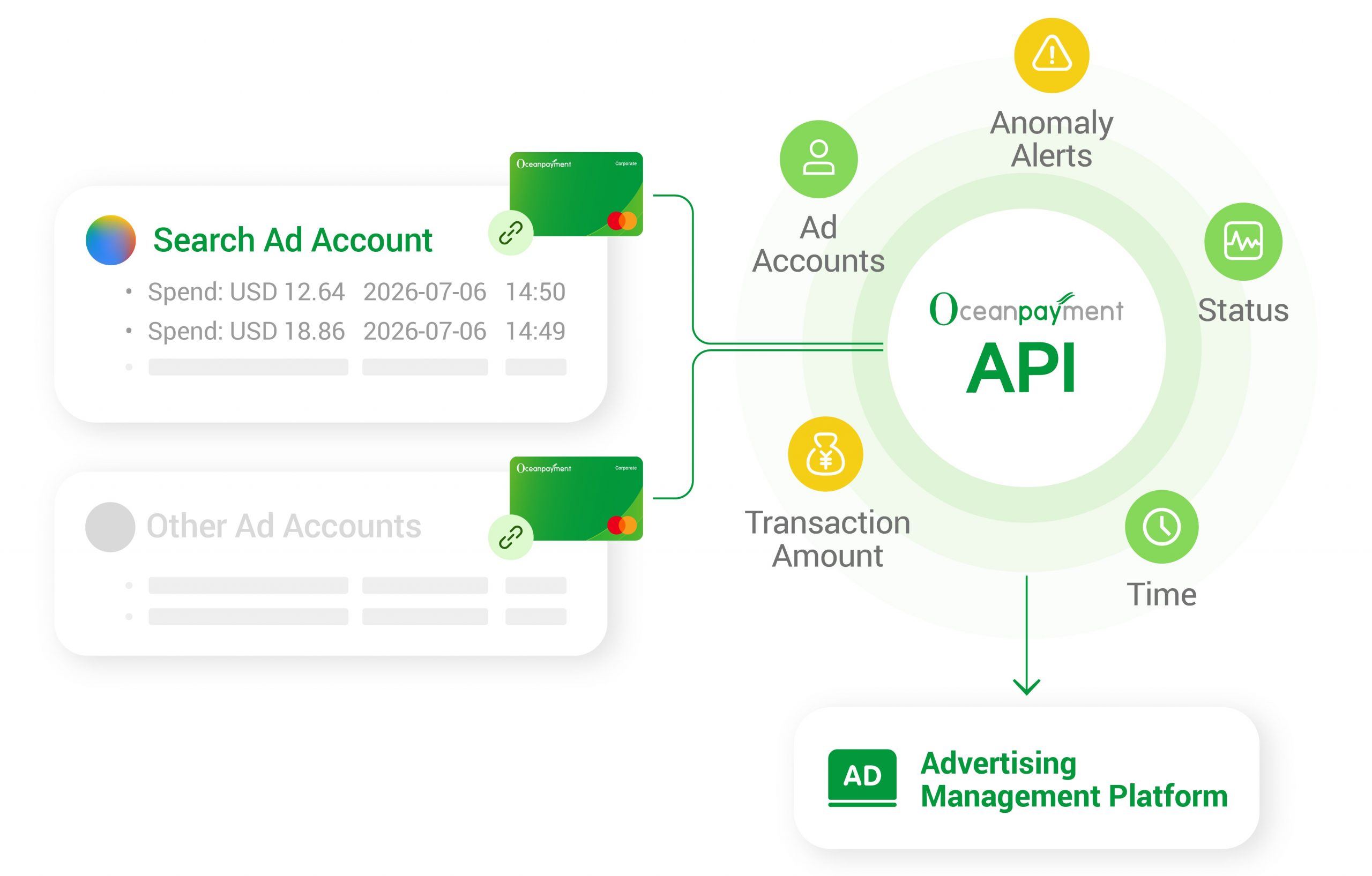
Businesses can view the ad account, amount, and time associated with each transaction. They can also set alerts, adjust spending limits, or freeze a card instantly in response to unusual activity, keeping advertising budgets under control.
All transaction data can sync with your ad management platform through API integration, enabling marketing and finance teams to manage and reconcile advertising spend in a shared view while reducing manual reconciliation work.
After Campaigns: Keep Every Transaction Traceable
After a campaign, complete transaction records can help businesses reconcile advertising spend more efficiently, reduce the time spent on manual checks, and keep each transaction traceable.
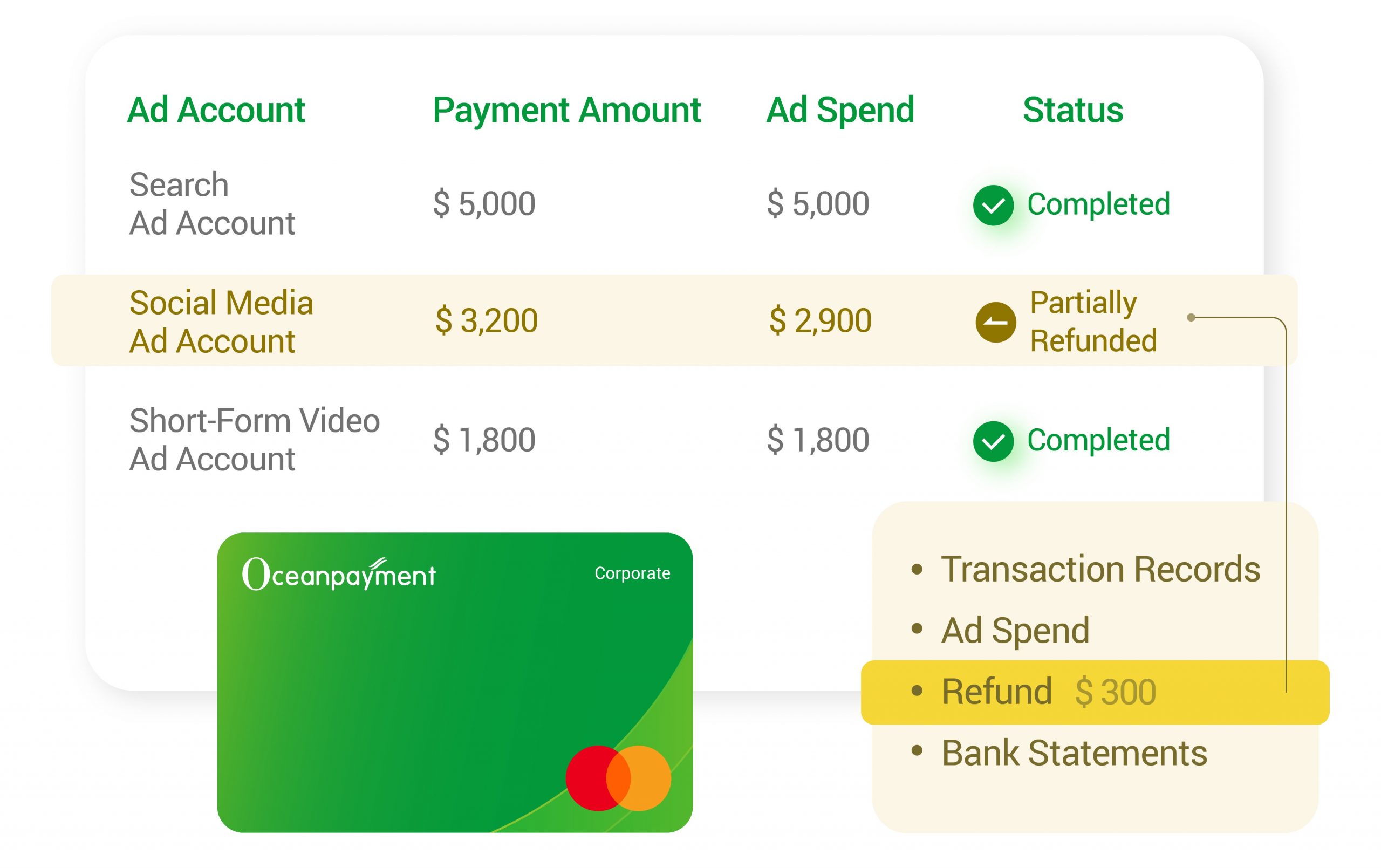
When teams need to investigate a transaction or reconcile funds, they can locate the relevant records more quickly to support follow-up action.
Unused funds returned by advertising platforms can be credited to the company’s virtual account for centralized management, connecting budget allocation, payments, transaction records, and refunds.
Businesses can maintain a clearer record of fund movements across advertising payments, reconciliation, and refunds.
What Changes When Businesses Upgrade the Way They Manage Advertising Funds?
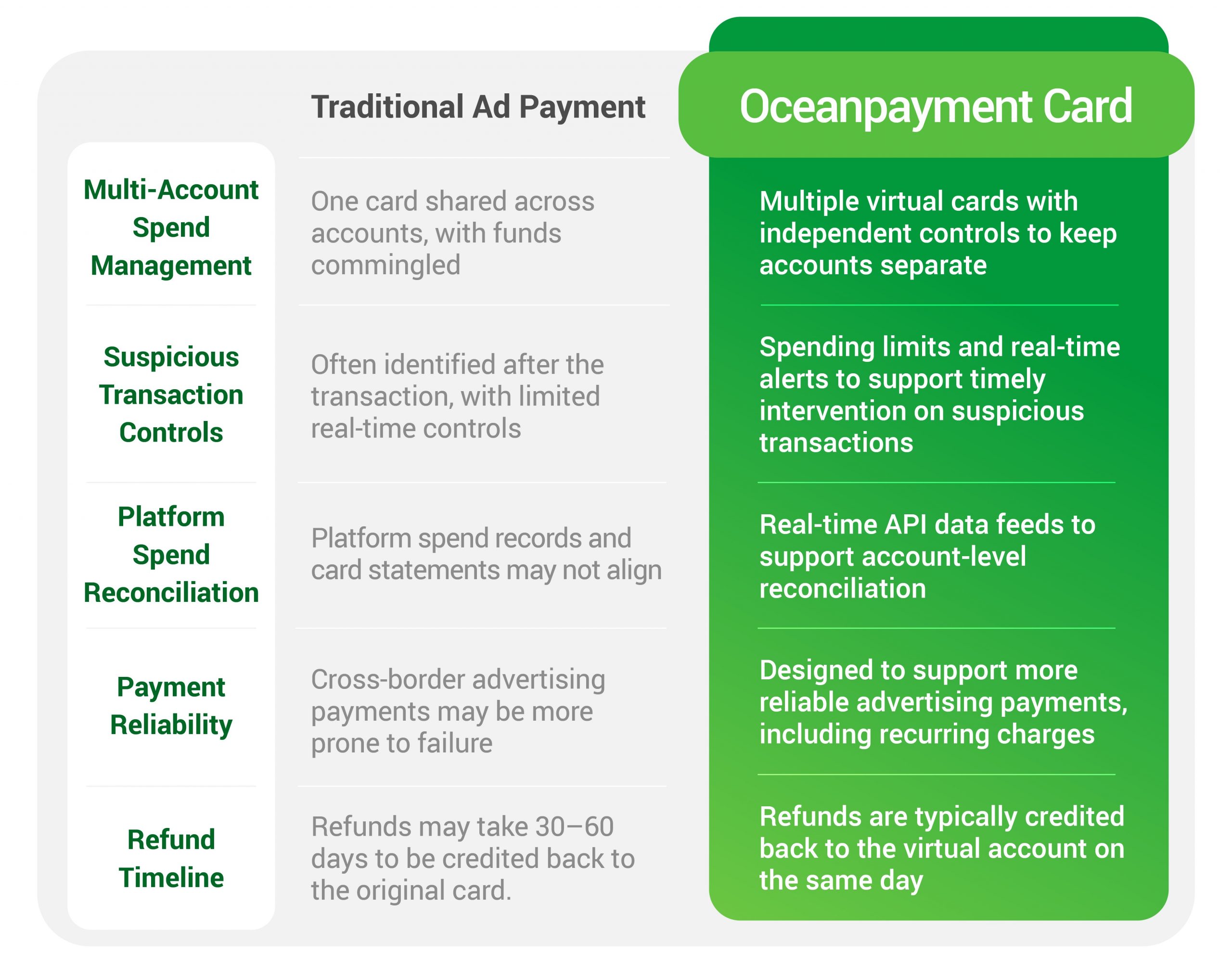
*This comparison is based on Oceanpayment Card use cases. Actual outcomes may vary depending on company processes, system configurations, business scenarios, and integration methods.
As advertising scales, the focus shifts from managing accounts to managing the funds behind them. Unified management of budgets, payments, transactions, and refunds helps advertising operations remain stable and manageable as they scale.
From completing payments to driving business growth, advertising spend management is becoming a core capability for businesses running global advertising campaigns.





 粤公网安备 44030502003453号
Comments are closed.